gavenea

gavenea

Sorin Gavenea, founder of Gavenea Studio. Builds fast, conversion-focused websites for B2B SaaS companies. gaveneastudio.com

WordPress vs Webflow vs Framer

Editorial illustration comparing WordPress, Webflow and Framer as platforms for B2B SaaS

WordPress vs Webflow vs Framer for B2B SaaS in 2026 - the honest comparison. Framer for design-led speed, Webflow for managed no-code, WordPress for ownership and flexibility. A factor-by-factor scorecard, the cost model that surprises teams, and a verdict by funding stage.


WordPress for SaaS

Editorial illustration representing a disciplined WordPress build for a funded SaaS startup

Is WordPress good enough for a funded SaaS startup? Yes - but only when it's built with discipline. The honest version: where WordPress's bad reputation really comes from, what it genuinely gives a funded SaaS, where it's the wrong call, and why the platform is rarely the thing that decides whether your site succeeds.

B2B SaaS website pages

Editorial illustration of the core B2B SaaS website pages arranged as a lean sitemap

A B2B SaaS website needs 7–10 core pages: home, product, pricing, proof, about, contact, legal. More pages usually mean less conversion, not more. The page-by-page map, the pages you can safely skip, the two-click test, and the point where adding pages actually starts paying.

Website Rebuild or Refresh

Editorial illustration comparing a surface refresh with a website rebuild on new foundations

A refresh fixes the visible layer - visuals, copy, a slow page. A rebuild replaces the thinking underneath. Choosing wrong is expensive in both directions. Here are the five signs your SaaS website needs rebuilding, the signs a refresh is enough, and the 70% rule for deciding.

B2B SaaS Website Conversion

Editorial illustration of a clear path to action representing B2B SaaS website conversion

The average B2B SaaS website converts 2–5% of visitors. The top 10% convert at 8–15% - on the same traffic. The difference isn't luck or ad spend: it's message clarity, buyer-led structure, specific proof, low friction, and speed. Here's what the data says actually moves the number, and what quietly doesn't.

Core Web Vitals explained

Editorial illustration of the three Core Web Vitals explained: loading, responsiveness and layout stability

Core Web Vitals are the three numbers Google uses to grade how your site feels to real visitors - and as a SaaS founder, you don't need to be technical to understand them. Plain-language explanations of LCP, INP and CLS, the passing grades, and the one question to ask your team.

Slow Website SaaS Signups

Editorial illustration of a slow website leaking SaaS signups from a conversion funnel

A slow website doesn't announce itself - no error, no complaint. It just quietly sheds signups at every funnel stage while you see only the conversions you got, never the ones that left. Here's the real cost of slow speed for B2B SaaS, the data behind it, and how to find your leak.

We rebuilt our own website

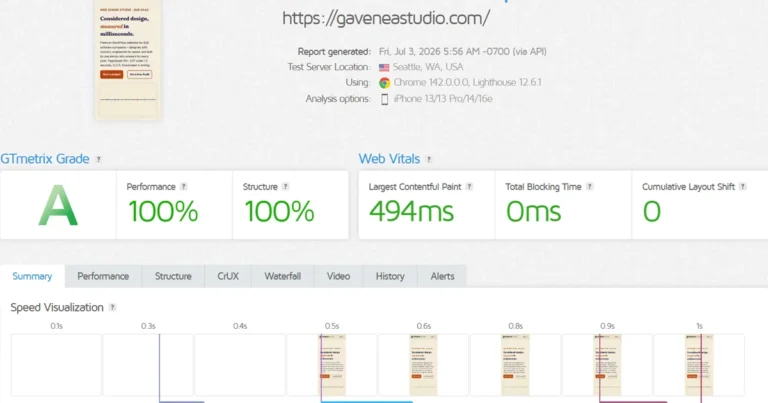
GTmetrix performance report for gaveneastudio.com - Grade A, 100% performance, 494ms Largest Contentful Paint, 0ms Total Blocking Time

When we rebranded from Strategy Growth Agency to Gavenea Studio, we treated our own website as our hardest client. Here's what changed during the rebuild and migration to Kinsta - and the before-and-after numbers, measured in public.

PageSpeed score vs field data

Editorial illustration contrasting a clean PageSpeed score dial with messy real-world field data

A perfect PageSpeed score feels like a win - but it's lab data, and Google ranks you on something else: field data from real visitors. Here's why a 100 can still fail Core Web Vitals, what the two numbers in PageSpeed Insights actually mean, and which one to trust.

Website Performance Audit

Editorial illustration of a website performance audit inspecting a webpage

A real website performance audit isn't a Lighthouse screenshot. It's a diagnosis: which pages fail Core Web Vitals, why each one fails, and the prioritised fixes that will actually move your real-world speed. Here's exactly what a thorough one includes - and what it leaves out.